Panacea Bio ChemPleniDose™ Gantry · Cartridge-filling platform
Platform brief Rev 2026-07
PLATFORM PleniDose GantryLINES Lyoprester · LiquipresterSHARED CONTROL motion · datum · metered dispensingLIQUIPRESTER MODE Cryoviscous · ElimiVoid · IncreSureLYOPRESTER MODE dual-chamber filling · Vana Machine preparation
Filling Platform · Motion Control · Controlled-Dose Discipline
PleniDose™ Gantry — one platform, two cartridge architectures
The glass may vary. The dose must not.
The same motion platform and datum-control architecture serve both the
dual-chamber Lyoprester and liquid Liquiprester lines. The interchangeable
rod-holder assembly establishes the cartridge format, while the software recipe and the
product-specific filling sequence determine how each cartridge is processed. One shared machine
and one shared control philosophy — not one identical process.
A Panacea Bio Chem platform brief · by Bogdan Dicoias, biochemist and inventor
· Subject: shared cartridge-filling gantry ·
Platform: PleniDose Gantry (Panacea) ·
Nothing here is medical advice.
PleniDose™ Gantry
Controlled, repeatable motion is the whole game. The PleniDose™ Gantry
is the platform Panacea Bio Chem uses to fill two very different cartridges with one shared
dose discipline. Designed by Bogdan Dicoias.
Platform brief
PleniDose™ Gantry is the shared manufacturing platform at the centre of the
Panacea cartridge lines. The core idea is deliberately economical: one physical gantry
makes both products, from one shared motion and datum-control platform. Fit the dual-chamber
tooling and it produces a
Lyoprester®;
fit the liquid tooling and the same machine produces a
Liquiprester™
— the interchangeable rod-holder assembly establishes the cartridge format, and the gantry then
runs the product-specific Lyoprester® or Liquiprester™ process recipe. It is one
shared machine and one shared control philosophy, not one identical process. On the
Liquiprester line the gantry sets the rear-plunger datum, meters a target 3.00 mL
primary aliquot within a defined process tolerance, coordinates Cryoviscous™
conditioning through temperature-controlled cartridge-holder assemblies, dispenses the
principal-additive-free ElimiVoid™ completion medium, runs a dual-cannula
slow top-up with a rapid drawback that removes the excess completion medium, and brings the
cartridge to closure readiness so it carries no visible air bubble, within a near-airless,
oxygen-depleted and argon-conditioned internal environment. On the Lyoprester line it fills
the dual chambers and stages the matched diluent for the separate Vana Machine™
vacuum step. The machine parameters are held by Bogdan Dicoias. It is a beneficial engineering
description, not medical advice.
Technology architecture — an 8-node ecosystem: seven enabling nodes (including the PleniDose™ manufacturing backbone) + the finished Liquiprester™
Seven enabling nodes — including the PleniDose™ manufacturing backbone —
converge in the finished Liquiprester™ platform (the eighth node): PleniDose™,
Cryoviscous™, ElimiVoid™, OxyDeplete™, ArgonLock™, RedoxVault™ and
IncreSure™. This is an 8-node ecosystem, not necessarily an 8-step linear sequence.
Most filling lines are built for one format. A cartridge line that fills a dual-chamber
cartridge — a freeze-dried cake in one compartment, its matched diluent in the other — looks
nothing like a line that fills a single liquid cartridge. Panacea took the opposite path:
build one gantry and let the tooling do the switching.
The motion platform, the coordinate system and the datum-control philosophy remain shared. The
active fluid operations, the process recipe and the finishing sequence are selected for the
cartridge line being produced. What changes between product lines is the rod-holder assembly —
the tooling that presents and registers the cartridge bodies to the machine; the gantry then runs
the product-specific Lyoprester® or Liquiprester™ process recipe. Fit the dual-chamber
rod-holder assembly and the gantry produces a
Lyoprester® cartridge →;
fit the liquid rod-holder assembly and the very same gantry produces a
Liquiprester™ cartridge →.
Either cartridge architecture may also support a compatible
Peptourbillon™
programme where the formulation and process have been specifically developed for it — a freeze-dried
cake in the dual-chamber body, or a curated blend held in a formulation-specific liquid architecture.
Keep one platform for both cartridges, and the dose discipline stops being a
per-product argument — it becomes a property of the machine.
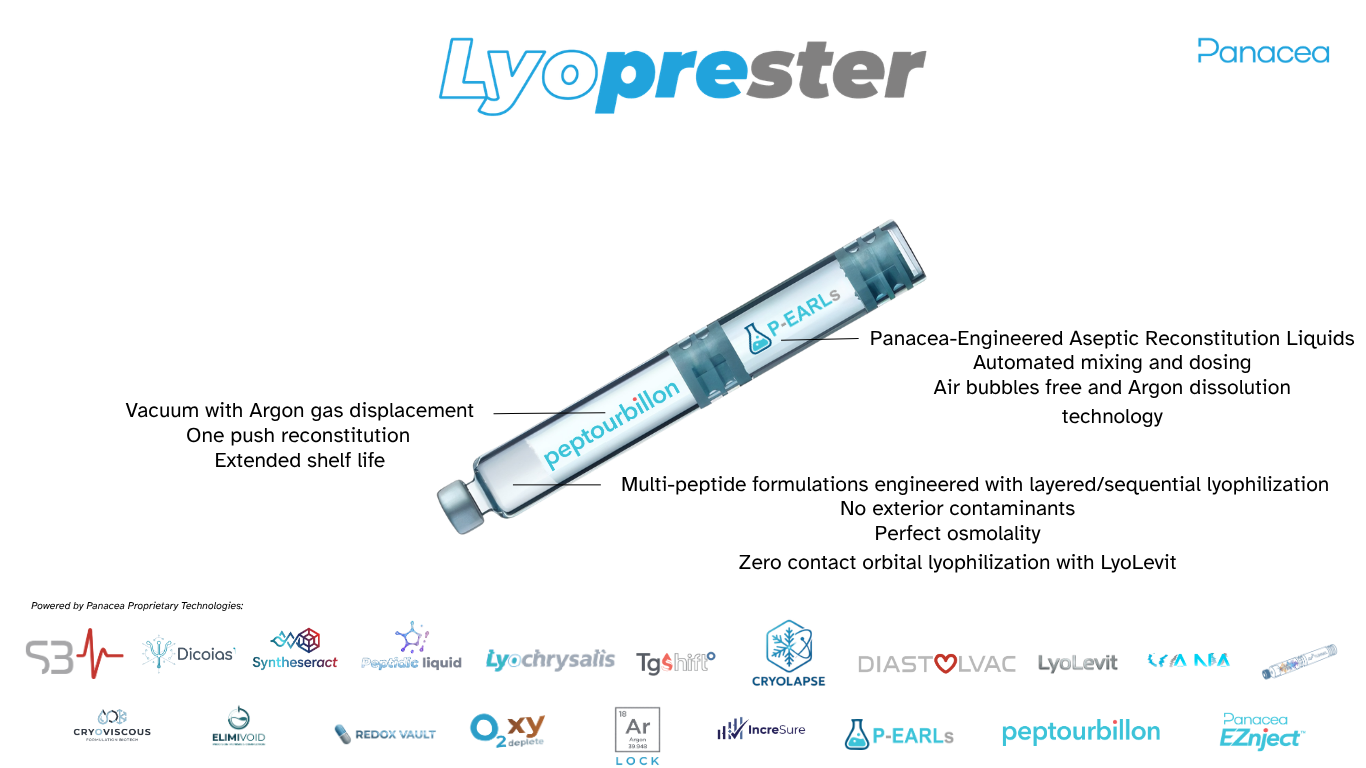
Lyoprester line
Dual-chamber rod-holder assembly. The gantry
fills the API chamber and stages the matched diluent, ready for the
Vana Machine vacuum step and plunger lock. A different machine finishes
the vacuum — the gantry does the filling.
Liquiprester line
Liquid rod-holder assembly. The gantry meters
the primary aliquot, conditions it to the cryoviscous state and completes
the cartridge with the dual-cannula move — one liquid, no dual chamber.
A note on the Vana Machine. The Vana Machine™ is a different
machine — it creates the vacuum for Lyoprester cartridges and plunger-locks them. It is not
the PleniDose Gantry and must never be conflated with it. The gantry establishes the fill
quantity and cartridge geometry; IncreSure™
maps the resulting API delivery per characterised increment. The Vana Machine vacuum-conditions
the Lyoprester line. Two machines, one stack.
02 // What the gantry controls
The platform's job is to turn a formulation and an empty cartridge into a finished,
controlled-dose unit while controlling the variables capable of causing dose drift. The gantry
provides six shared controlled functions common to both lines, then runs the
product-specific stages for whichever cartridge is in tooling.
Shared gantry controls — both lines
Motion & position
Coordinated, repeatable X/Y/Z motion under the shared
motion-control platform — the common backbone both process recipes run on.
Cartridge registration
The interchangeable rod-holder assembly presents and
registers the cartridge bodies to the machine, establishing the format before the line-specific
recipe runs.
Rear-plunger datum
The rear plunger is set to a fixed, pen-compatible datum —
the reference position from which every downstream increment is measured. Establish the datum
correctly and an EZnject™ / IncreSure™
pen can index the cartridge into characterised mechanical increments mapped to recoverable API
output.
Metered dispensing
Volume-controlled delivery of the fill liquids to a defined
process tolerance — the metering discipline both recipes share.
Closure readiness
The cartridge is brought to a defined state ready for closing —
handed on to the line-specific closure step (Vana Machine™ on the Lyoprester line;
completion-medium closure on the Liquiprester line).
Process traceability
Each controlled step is referenced to a measured datum, so the
finished cartridge is a consequence of the machine's control rather than the operator's hand.
Liquiprester-specific stages
Target 3.00 mL
primary aliquot within a defined process tolerance · Cryoviscous™
conditioning through temperature-controlled cartridge-holder assemblies · ElimiVoid™
completion with a principal-additive-free, buffer-free, lighter, warmer completion medium ·
a slow top-up at one cannula and a rapid drawback at a second, at the calibrated
meniscus, that removes the excess API-free completion medium while the API-containing primary
aliquot stays protected below the withdrawal zone.
Lyoprester-specific stages
Dual-chamber aliquoting ·
staging of the API and its matched diluent in the two chambers · preparation of the cartridge for
the separateVana Machine™ vacuum step and plunger-lock. The
finishing sequence here is chamber filling and Vana preparation, not the Liquiprester completion
move.
Both lines share the six controlled functions above; the completion medium, the
Cryoviscous™ conditioning and the dual-cannula drawback are Liquiprester-specific, while
dual-chamber staging and Vana Machine™ preparation are Lyoprester-specific. One shared machine
and control philosophy — not one identical process.
Metered, unhurried fluid delivery — the physical discipline behind the gantry's
dual-cannula completion move. Panacea Bio Chem, by Bogdan Dicoias.
03 // Slow top-up, fast drawback
The completion move is the signature of the platform, and its rhythm matters. The
principal-additive-free ElimiVoid™ completion medium is added slowly and gently,
delivered above a transient first-contact interfacial barrier so the incoming liquid is
designed not to stir the API-containing layer beneath it. Then the finishing cannula
withdraws rapidly at the calibrated meniscus, removing the excess API-free completion
medium in a single quick motion — without moving the rear plunger, so the API-containing
primary aliquot stays protected below the withdrawal zone.
The asymmetry is the point. A slow, above-barrier addition keeps the layers ordered; a fast,
precise drawback removes the excess completion medium before the layers have a chance to intermix.
That interface, per
Panacea's corrected doctrine, is a single-cycle, first-contact phenomenon: when the
completion medium first contacts the Cryoviscous™ primary formulation, a transient barrier
forms under the defined process conditions and protects the primary aliquot during completion and
excess withdrawal. After controlled warming, the layers homogenise above the
formulation-specific interface-release temperature, and the process does not re-form the original
interface during subsequent qualified cooling cycles. It is a contact-induced structuring, not a
repeatable temperature-driven two-phase system.
Gentle in, quick out — the addition is unhurried, the finishing withdrawal is fast, and the plunger never moves.
04 // No visible air bubble, argon-conditioned
The finished Liquiprester™ carries no visible air bubble, within a
near-airless, oxygen-depleted and argon-conditioned internal environment — the product of
three cooperating steps in the process stack, each with its own site, each with a distinct role:
OxyDeplete™
reduces the dissolved and entrained atmospheric gases in the fill liquids before the cartridge is
completed.
ArgonLock™
applies controlled argon conditioning that reduces oxygen exposure and supports oxygen removal by
mass transfer, establishing an argon-enriched liquid and closure environment.
ElimiVoid™
replaces the deliberate compressible front void with completion medium, so the finished cartridge
shows no visible air bubble.
Together they remove the intended air gap and drive residual oxygen low. The claim is
precise and honest: not that every molecule of dissolved gas is gone, but that the deliberate
compressible front void is eliminated and oxygen exposure is reduced. Around all of this sits
RedoxVault™,
Panacea's formulation-specific oxidative-protection architecture, whose implementation is selected
according to the active ingredients, excipients and phase structure of each formulation — not one
identical mechanism in every cartridge.
05 // Process-control philosophy
The gantry is built on a simple engineering stance: a dose is a controlled quantity, not a
hopeful one. Every step above is defined by a measured reference — a datum, a metered volume,
a conditioned viscosity, a calibrated meniscus — so that the finished cartridge is a consequence
of the machine's control, not of the operator's hand. That is why one platform can serve two very
different cartridges without the dose discipline changing: the discipline lives in the motion
control and the datums, and the tooling merely presents the glass.
Watching over the wider peptide cycle is the
S3Pulse™ biointegrity engine,
which keeps the record so each cartridge is the preparation the formulator intended — the same
discipline Panacea brings to every fragile chain, here in the service of a controlled fill that
leaves no visible air bubble.
06 // The idea, in one table
How one platform serves two cartridge lines
Element
Lyoprester line
Liquiprester line
Rod-holder assembly
Dual-chamber tooling
Liquid tooling
Cartridge
Cake + matched diluent, two chambers
Single co-formulated liquid
Plunger datum
Fixed, pen-compatible
Fixed, pen-compatible
Primary aliquot
Metered by the gantry
Target 3.00 mL primary aliquot
Finishing
Product-specific dual-chamber filling; staged for the Vana Machine vacuum step
Product-specific chamber filling with Vana Machine™ vacuum conditioning & closure control
ElimiVoid™ front-void completion within a near-airless, oxygen-depleted, argon-conditioned environment
Named steps describe the platform's public architecture. PleniDose™ is a
proprietary Panacea Bio Chem platform designed and invented by Bogdan Dicoias; its underlying machine
parameters and process specifications are not published. No dose, outcome or health claim is made here.
07 // The engineering lineage
The idea that a single, well-datumed motion platform can outperform a hand process is old and
well earned. Automated aseptic
filling3 replaced variable manual filling precisely because a
machine holds a reference the hand cannot. Modern
motion control7
turned that reference into micrometre-scale repeatability, and the same gantry-and-tooling logic
that lets a machine tool change heads to make different parts is what lets the PleniDose Gantry
change rod-holder assemblies to make different cartridges.
What Panacea adds is the dose layer on top of the motion layer: the plunger datum, the
controlled primary aliquot, the Cryoviscous™ conditioning and the dual-cannula completion, so that
precision of movement becomes precision of delivered dose. The PleniDose Gantry is that
platform — one machine, a name that says what it is for.
One gantry runs both product lines, controlled by S3Pulse and
KineticON™: Lyoprester builds the dual-chamber cartridge, Liquiprester
fills and closes the liquid one.
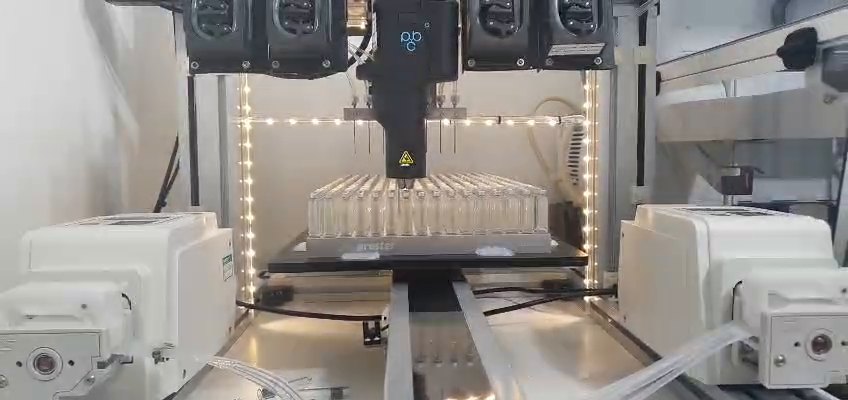
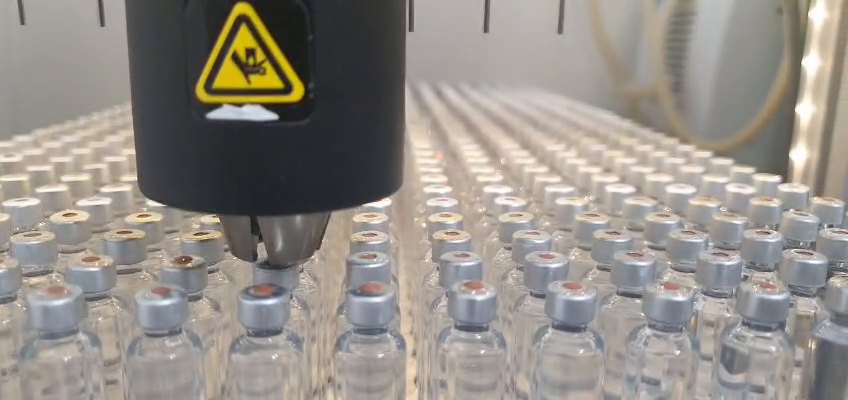
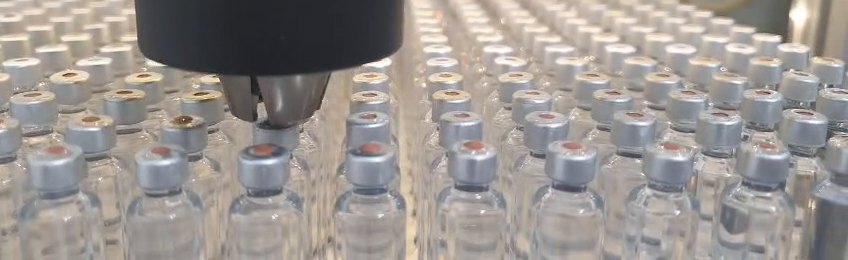
Aliquoting and crimping. The eight-cannula
head fills a loaded holder and the crimper closes it — axes, pumps, tool change and run state driven as one
machine.Liquiprester. The titanium holder
(Ti 6Al-4V ELI, Gr23-medical) and the finished cartridge: filled, plunger seated, crimped closed.
Lyoprester — dual chamber
Peptidic liquid aliquoting, prior to lyophilization
Middle plunger insertion
P-EARLs aliquoting
Top plunger enclosing of P-EARLs, without air bubbles
Cartridge enclosure by crimping the alu/septa cap
Liquiprester — liquid cartridge
Plunger insertion
Peptidic liquid
Cartridge closure, without air bubbles
Why the closure is the product
Watch the Liquiprester sequence and there is no air bubble left behind the plunger. That is not cosmetic. Trapped
oxygen does not sit quietly in a cartridge — it reacts, and it spends the shelf life of the peptide doing so.
Panacea removes it before closure with OxyDeplete™, dissolves argon into
the peptidic liquid and seals under it with ArgonLock™, and places the
trace metal catalysts that would otherwise drive oxidation out of reach with
RedoxVault™. Together with the rest of the Panacea stack, that is what
makes this peptidic liquid cartridge the longest-lived on the market.
What the gantry makes possible downstream
Precision at this stage is what later technologies stand on.
IncreSure™ can verify the API in each pen increment because the piston
travel behind that increment was a measured motion, not a printed dial figure.
ElimiVoid™ can clear the compressible void ahead of the dose without
moving the rear plunger or withdrawing a microlitre of API, because the machine knows exactly which axis may move
and which must not. And Cryoviscous™ holds the formulation cold, stiff
and slow so it can be placed exactly — which changes the force, the timing and the settle the gantry has to
get right. Each one is a promise about a movement, kept by
S3Pulse and KineticON™.
08 // Where the platform reaches furthest
A shared, controlled-dose filling platform is a broad, high-leverage idea. Directions where it
matters most include:
Dual-chamber cartridgesLiquid cartridgesControlled-aliquot dosingPlunger datum controlNo-visible-air-bubble finishCryoviscous conditioningDual-cannula completionPen-compatible cartridges
Fragile peptide payloads. Formulations that will not tolerate turbulence or an air
pocket benefit most from Cryoviscous™ conditioning and a no-visible-air-bubble finish.
Multi-format product families. A line that must make both a dual-chamber and a liquid
cartridge gains from sharing one datumed platform rather than running two.
Pen-indexed delivery. A fixed, pen-compatible plunger datum is what lets an
EZnject™ pen and IncreSure™
map a cartridge into characterised mechanical increments mapped to recoverable API output.
Oxidation-sensitive actives. The near-airless, low-oxygen internal environment pairs
naturally with formulation-specific oxidative protection such as
RedoxVault™, whose implementation is selected per formulation rather than a single universal mechanism.
These fields are offered as a map of engineering and product opportunity and
future research direction, not as indications or advice.
The output the platform exists for: a row of cartridges, each metered to the same
target aliquot and finished with no visible air bubble. Panacea Bio Chem, by Bogdan Dicoias.
Frequently asked
What is the PleniDose Gantry? Panacea Bio Chem's shared cartridge-filling platform —
one physical gantry that produces both the dual-chamber Lyoprester cartridge and the liquid
Liquiprester cartridge from one shared motion and datum-control platform. The interchangeable
rod-holder assembly establishes the cartridge format, and the gantry then runs the product-specific
Lyoprester or Liquiprester process recipe — one shared machine and control philosophy, not one
identical process. On the Liquiprester line it sets the plunger datum, meters a target 3.00 mL
primary aliquot within a defined process tolerance, coordinates Cryoviscous™ conditioning
through temperature-controlled cartridge-holder assemblies, and runs a dual-cannula slow top-up
with rapid drawback so the finished cartridge carries no visible air bubble. The machine parameters
are proprietary to Bogdan Dicoias. Nothing here is medical advice.
How does one gantry make two different cartridges? The motion platform, the coordinate
system and the datum-control philosophy remain shared; the active fluid operations, the process
recipe and the finishing sequence are selected for the cartridge line being produced. The
rod-holder assembly establishes the format — dual-chamber tooling runs the Lyoprester recipe,
liquid tooling runs the product-specific Liquiprester recipe. The two lines run different
product-specific recipes on a common datum-controlled platform.
What does "slow top-up, fast drawback" mean? It is the dual-cannula completion move:
the principal-additive-free ElimiVoid™ completion medium is added slowly and gently above a
transient first-contact interfacial barrier, then a second cannula withdraws rapidly at the
calibrated meniscus — removing the excess API-free completion medium without moving the rear
plunger, so the API-containing primary aliquot stays protected below the withdrawal zone.
Is it the same as the Vana Machine? No. The Vana Machine™ is a different
machine that creates the vacuum for Lyoprester cartridges and plunger-locks them. The PleniDose
Gantry does the filling and dose-setting; the Vana Machine does the vacuum step. They must never
be conflated.
Who designed it? The PleniDose Gantry was designed by Bogdan Dicoias and is
the intellectual property of Panacea Bio Chem Ltd. Its underlying process parameters and
rod-holder-assembly specifications are a proprietary Panacea programme.
Trending in the field
Recent developments in the field — refreshed 2026-10-08 by Panacea Bio Chem.
ISO 11608-1 and ISO 11608-3 — needle-based injection systems for medical
use: requirements and test methods for the delivery system and for the containers and cartridges,
including dose accuracy across the delivery stroke. Named standard; further reading:
pen-injector systems (Wikipedia).
ISO 13926 series — pen systems: glass cartridge and plunger/stopper dimensions
for pen-injectors. Named standard; further reading:
autoinjector / cartridge systems (Wikipedia).
Sterile drug products produced by aseptic processing — FDA current good
manufacturing practice guidance and EU GMP Annex 1 on sterile medicinal products; automated
sterile cartridge filling replaces variable manual filling.
FDA aseptic-processing guidance;
aseptic processing (Wikipedia).
Stopper / plunger-position and pen dose-accuracy in cartridge-based injection systems —
the datum reference that governs delivered dose. Further reading:
injection systems (Wikipedia).
Fill-finish headspace and dissolved-oxygen (DO) control in parenteral packaging —
reducing oxidative exposure of the finished container. Further reading:
oxygen scavenging (Wikipedia).
Interfacial gelation and low-temperature rheology of peptide and protein solutions —
the physical basis for a temperature-conditioned, high-viscosity completion window. Further reading:
rheology (Wikipedia).
Automated cartridge filling and motion control — coordinated, repeatable machine movement
enabling dose-uniformity across a pen delivery stroke. Further reading:
motion control (Wikipedia).
Argon as an inert conditioning gas for low-oxygen environments, and freeze-drying
(lyophilisation) as the drying route behind the dual-chamber cartridge.
Argon (Wikipedia);
freeze-drying (Wikipedia).
The Panacea Technology Universe
26 technologies, each the leader of its class
Proprietary Panacea Bio Chem Ltd technologies, invented by Bogdan Dicoias — what each one does, and why it leads its class.
Publications indexed in PubMed in the last 30 days for ("aseptic filling"[tiab] OR "fill-finish"[tiab] OR "fill finish"[tiab] OR "fill and finish"[tiab] OR "filling process"[tiab] OR "filling line"[tiab] OR "filling operation"[tiab] OR "filling operations"[tiab] OR "cartridge filling"[tiab] OR "vial filling"[tiab] OR "syringe filling"[tiab] OR "fill volume"[tiab] OR "fill weight"[tiab] OR "filling accuracy"[tiab] OR "piston pump"[tiab] OR "piston pumps"[tiab] OR "peristaltic pump"[tiab] OR "peristaltic pumps"[tiab] OR "time-pressure"[tiab] OR "dual-chamber"[tiab] OR "dual chamber"[tiab] OR isolator[tiab] OR isolators[tiab] OR "aseptic processing"[tiab]) AND (cartridge*[tiab] OR syringe*[tiab] OR vial[tiab] OR vials[tiab] OR parenteral*[tiab] OR "drug product"[tiab] OR "drug products"[tiab] OR injectable*[tiab] OR biologic*[tiab] OR "therapeutic protein"[tiab] OR "monoclonal"[tiab] OR sterile[tiab] OR "sterile"[tiab]) NOT (dental[tiab] OR "root canal"[tiab] OR endodont*[tiab] OR anesthetic[tiab] OR anaesthetic[tiab] OR "e-cigarette"[tiab] OR hospital[tiab] OR pharmacist*[tiab] OR "internet of things"[tiab] OR IoT[tiab] OR "case report"[tiab] OR "3D print"[tiab] OR "3D-print"[tiab] OR radiopharm*[tiab] OR chemotherap*[tiab] OR "cell therapy"[tiab] OR cannabis[tiab]) — refreshed weekly.